.png?width=1887&height=531&name=Becks_Logo_2_Horizontal_D_FullColor.png%20(1).png)
Good Morning!
Good Morning!
I hope you’ve had a great weekend. This report was written on Saturday morning.
We have been doing what most of you have been doing, running as hard as we can. I’m not sure if we can get it done by Saturday night, but that’s the goal as I write this. We’re down to the short rows, and about all of what we have left is going in the bin. We wanted to save the bins for later corn as we were afraid the lines would get longer the farther into harvest we went. That’s been the case, with a couple of days when we got slowed down by long lines. I can’t complain much about yields; while our late beans weren’t that good, it isn’t hard to fathom, given how dry we finished. We still have no rain in sight, and that’s a concern if we’re going to head into the winter with this little moisture in the ground. We won’t likely do a ton of fieldwork just yet, especially with how dry it is. Heck, I’m not sure we’ll be able to put anhydrous on without some moisture here sooner or later. Either way, we’re about to shift our focus in the next few days. I appreciate the feedback—keep us up to date on how things are going for you.
My podcast on Beck’s YouTube Live last week was actually from the combine while I was waiting for things to dry a bit. I’ve heard from a few of you who have been tuning in. Let me know the topics you’d like me to address. CLICK HERE for more info on the AgMarket app. https://hubs.li/Q03qt2Qd0
The corn and bean markets were lower on the week, likely due to hedge pressure and the trade fiasco we’re in with China. With China slapping on more stringent export controls on rare-earth metals, President Trump announced that the proposed meeting with President Xi was off. He also announced 100% additional tariffs on China, effective November 1. The trade war is back on, and most markets didn’t like that news at all. With the government shutdown continuing, we missed the October USDA report and the other weekly reports they released. Outside markets were mixed.
- The US Dollar was up 317 at 98.732
- December crude oil was down 05 at 58.48
- The DOW was down 1,325 points at 45,706.
CORN
December 2025 corn didn’t do much until Friday, when selling came in. On Friday, December settled at $4.13, down 5 ¼. This was 6 ¼ off the high and ¾ off the low. December lost 6 cents for the week. Harvest is in full swing, where producers aren’t already finished. The amount of grain moving right now certainly puts some pressure on the markets as some corn is inevitably being sold across the scales. Given the tightness of money for most of us and the high price of commercial grain storage, cash sales are likely putting pressure on the market. While trade issues with China aren’t likely affecting the corn market as much as we’d think, as with beans, weakness for beans certainly spills over to corn. For instance, an acreage discussion must include how excited growers are to plant both beans and corn. It’s going to be quite interesting as we move through the winter. For now, I like having ownership of corn more so down the road than I do today. It may take some patience to see a pop in this market, so locking in worst-case scenarios will likely be what we’re talking about for the next several weeks.
DEMAND
Corn demand is still a bit of an unknown. We still have no export sales report due to the shutdown. Ethanol grind jumped 7mb to 103 MB. Stocks were a shade lower. Basis was mixed:
- My local basis: 30 under Dec (a nickel improved)
- Decatur: 13 under the Dec (13 cents wider)
- Louis River: 17 over Dec (7 cents improved)
CASH CORN
Cash prices were lower on the week. While it’s not uncommon to see cash prices weak as we head through harvest, we see some areas narrow the basis. When harvest starts to wind down, this is a feature we commonly see as elevators and end-users try to latch on to the last remaining bushels in play. The issue with basis narrowing is that we aren’t gaining much with the board moving lower. It’s a tough deal on bushels heading to the elevator with the big storage costs. With basis already improving somewhat, it would be tough for me to pay for storage. If it’s going to cost us 40-50 cents to get out to next spring, I’d rather sell the corn, get my hands on some money, and own corn with calls or call spreads for a third of what that storage cost might be. In this scenario, we may give up some basis appreciation, but I’m not sure basis will come close to taking care of what we’ll invest in storage. At that point, we’re at the mercy of what this corn market might do. It’s tough to be bullish when looking at old-crop stocks, but I’m still of the opinion these cheap prices are keeping demand strong, and this could provide support on down the road.
2026 CORN
December 2026 corn ended the week at $4.53 ¼, down 8 ½. While I’ve felt December 2026 was too cheap due to the cost of putting this 2026 crop in the ground, we’re still seeing some weakness. We may be in a tough spot for 2026 if bean prices continue to weaken. I know many growers are asking if we should lock in some corn above $4.50, and it’s a good idea if the grower can maintain some flex. I’m not opposed to a strategy that locks in a floor while keeping upside open. The issue I have with $4.50 basis the board is most of us can’t make much money given how expensive fertilizer and other inputs continue to be. Last winter, we put on some strategies with clients just like this, and while we never got much chance at a rally, those floors, which were above $4.70 proved to be solid levels to be protected at. Let us know if you’d like to lock in some worst-case scenarios.
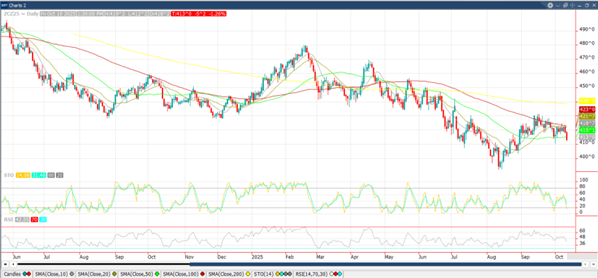
Corn Market Theme: The corn market isn’t doing much at all. I’m still not bearish down here, but it’s tough to be bullish in the short run. Keep flexible in your plan and consider corn ownership on a limited-risk basis.
SOYBEANS
Beans also faltered heading into the weekend as traders were disappointed with the breakdown in US/Chinese relations. On Friday, November beans settled down 15 ½ at $10.06 ¾. This was 18 off the high and 4 ¼ off the low. Beans lost 11 ¼ cents on the week. October meal settled 3.3 lower on the week at 267.4, while soy oil ended the week at 49.40 down .03. This past week, the biggest news, of course, was the cancellation of this meeting between Trump and Xi at the end of the month. Many of us were under the impression that progress had been made and that both sides were prepared to reach a deal. Given that appears to be far from reality, the current absence of Chinese business continues. This keeps our export situation tenuous at best. While other customers in the world have bought beans and bean products, China is by far and away the lion’s share of the world bean export business. With the lack of a trade deal, we’re likely looking at ending stocks closer to 400-500 mb instead of the 300-ish we’ve been working with for the last few months. This would certainly keep a lid on bean rallies, but this is all assuming Brazil’s weather will be benign. If we see issues with Brazil’s weather in the next three months, it’s certainly possible we could get beans to rally. Without either of these two big issues providing support, it’s going to be a tough time to expect beans to rally.
DEMAND
As with corn, we had no export sales announced this past week due to the government shutdown. Basis was improving.
- My local beans: 35 under November (14 cents improved)
- Decatur: option the November (20 cents improved)
- River: 13 over November (22 cents improved)
CASH BEANS
Cash beans actually gained value in most places this week despite the move lower on the board. As with corn, in some areas we’re seeing buyers try to buy the last beans. In our area, you have to do some driving to find a bean field as most of them have been harvested. It’s been interesting of late to see the basis on the river improve as much as it has. Many in the industry felt there must be some export business driving cash prices a bit higher, but as we’ve discussed, it doesn’t appear to be China, which typically buys a ton of beans this time of year. For those harvesting beans now, if you can’t store them at home, it’s certainly tough to store them commercially. I like having some ownership with calls that are cheaper than storage, but I wouldn’t necessarily feel like we have to re-own all of them. For bushels in the bin at home, I’d be locking in the carry in the market. While we feel confident bean basis improves over time, there’s no way to know how the market might trade. Locking in, for instance, July beans up at $10.65 would seem like a wise decision. If you want help in managing the risk of these beans going in the bin, be sure to reach out to one of us. We’re here to help.
2026 SOYBEANS
November 2026 beans settled at $10.56 ¾, down 9 on the week. With this 2026 bean market, it seems they’re hanging in there a little better than cash beans. One thing is for certain: we don’t want to see beans fall out of bed. IF we can keep this 2026 bean price at $10.50 and above, it’s tough for me to think bean acres aren’t going to be up a fair amount. Given huge corn acres in 2025, the typical protocol would be for big bean acres this coming year. I know many of the growers we talk to are looking at more bean acres, partially due to the expense of putting corn in the ground. As with corn, I like a strategy locking an aggressive floor in place. To do that, we may have to give up the upside on a few bushels up at $12 and above. For me, that’s a tradeoff I’m more than willing to make on a portion of my production. Again, let us know if you want some help here. If we’re going heavy beans this next year, protecting some of what we currently see on the board would be wise.
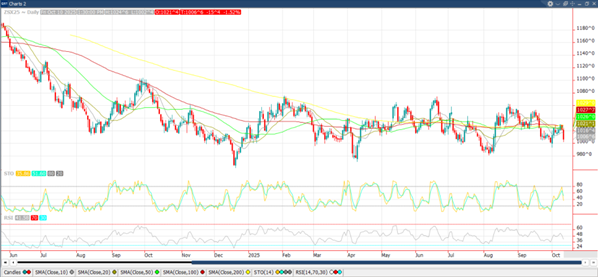
Soybean Market Theme: The bean market is fighting an uphill battle. With all the bearish news a guy can throw at it, we may struggle to rally for the time being. Hopefully, we’ll get cooler heads to prevail with this trade war sooner or later and get some good news.
As always, use the AgMarket.Net Profitability App to help you figure out your break-evens and put your plan in place.
Let me know if I can help in any way. These markets are tricky, but with a plan in place, we can take the emotion out and make better decisions.